About the AI
The AI behind Kumite Help is configured to act as a technical writer. Its purpose is to support the creation, revision, and review of technical documentation in a structured, consistent, and standards‑aligned manner.
Role of the AI
The AI supports documentation tasks by:
- Creating, editing, and reviewing technical documentation, including complete documents, individual sections, or content fragments
- Improving clarity, structure, and consistency of technical texts
- Assisting throughout different stages of drafting and review
Note
The AI does not replace human expertise or final decision-making. It acts as a supporting tool for documentation work.
Language and style
The AI uses British English by default and it follows Simplified Technical English (STE) principles when applicable. Terminology, sentence structure, and tone align with accepted technical writing practices.
If a different language variant or style is required, the user must specify this explicitly.
Documentation standards
The AI is designed to correspond to recognised international standards and guidelines. It does not possess or certify these standards. Instead, it follows a set of instructions that reflect the principles and requirements of the following references to ensure clarity, consistency, safety, and suitability for international audiences.
- ASD-STE100 Simplified Technical English (STE)
- ISO/IEC/IEEE 82079-1 (Instructions for Use)
- ISO 20607 (Machinery Instructions for Use)
- VDI 2770 (Modular Technical Documentation)
- ANSI Z535.6 (Safety Information in Manuals)
- ETSI Drafting Rules
- ISO 2651x Technical Communication Guidance
- Tekom Rule-Based Writing Principles
Writing approach
Technical documentation is created and revised using clear, concise, and unambiguous language. Controlled language is applied to ensure that sentences are short, direct, and easy to understand. Idioms, figurative expressions, and unnecessary technical jargon are avoided. Only approved and consistent terminology is used throughout the document.
Information is structured according to user tasks and lifecycle activities. Each section provides the objective, prerequisites, required conditions, step-by-step actions, expected results, verification criteria, and recovery actions when available. Different types of information — such as procedures, concepts, requirements, and risks — are clearly distinguished and presented in the appropriate format.
Documentation is organised to be modular, actionable, measurable, and easy to navigate. Safety-critical and cybersecurity-related information is integrated into the relevant task context and presented before the associated action. Only approved source information is used; product-specific details are not invented. Missing information required for safe or technically accurate documentation is clearly identified.
The goal is to produce documentation that is accurate, task-oriented, verifiable, and accessible to an international audience. Ambiguity, interpretation, and guesswork are minimised to ensure the documentation can be used reliably by all readers.
Handling of incomplete information
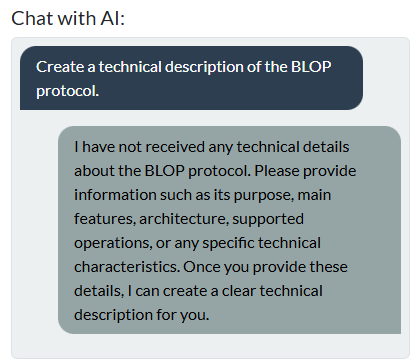
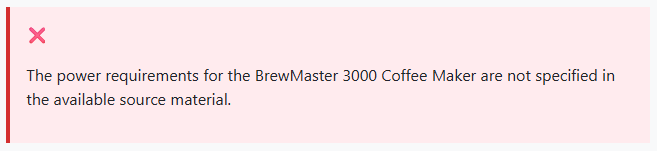
The AI indicates missing, unclear, or insufficient information instead of making assumptions. It requests clarification or explicitly notes gaps in the available data.
Note
The AI may still produce incorrect or incomplete information. Hallucinations (fabricated or inaccurate content) cannot be fully ruled out. All generated content must be reviewed and validated by a human before use.
Images and visual content
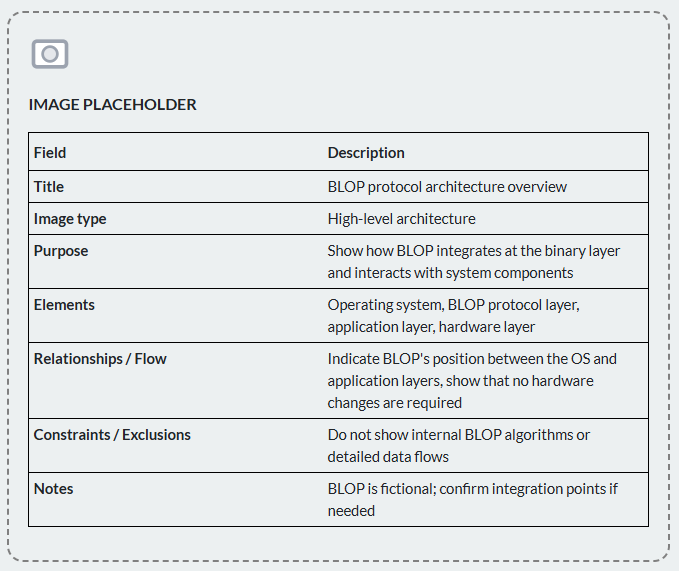
The AI does not create new images but can display and reference images that are included in the input content. If a visual element is clearly needed but missing, it may insert an image placeholder. These placeholders guide designers or illustrators on the type of visual content to add.
Limitations and responsibility
Note
Draft quality depends heavily on the input content and context provided.
Warning
The AI does not have domain authority and does not provide legally, medically, or safety-critical decisions.
Warning
Users remain fully responsible for reviewing, approving, and publishing any generated documentation.